Quantum Chemical
First Principles Design of Single Supermolecule Photoactive Machines
and Molecular Classical and Quantum Logic Devices
Arvydas Tamulisa,
Jelena Tamulienea, Zilvinas
Rinkeviciusb, Vykintas Tamulisa,c
aInstitute of Theoretical Physics and Astronomy, A. Gostauto 12, 2600 Vilnius, Lithuania
bKTH, SCFAB, Dept. of Biotechnology, Theoretical Chemistry, S-106 91 Stockholm, Sweden
cVilnius Gediminas Technical Univ., Faculty of Fundamental Sciences, Vilnius 2040, Lithuania
Quantum mechanically ab initio and Density Functional Theory-Time Dependent (DFT-TD)designed light-driven, single supermolecular devices based on fullerene, biliverdin and photoactive molecules and supermolecules could form the basis for logically-controlled organic molecular machines and molecular classical and quantum computers [1-12]. Organic and organo-metallic molecular computers have advances in nano-size and pico- or even femto-second speed as well as of in principle new quantum computation compared with conventional silicon-based chips.
Theoretical molecular physics can provide the basic understanding needed to design such a single supermolecule devices by calculating the optimized geometries, quantum state energies, electron and proton charge transfer, NMR, EPR, etc. of candidate molecules and suggesting new supermolecules molecules with the desired quantum properties. Using advanced computational physics tools we, for instance, elucidated the energies and pathways of optically-induced charge transfer and the trans-cis isomerization of azo-dyes based supermolecules [13], and the electrical and magnetic properties ofa fullerene and biliverdin derivatives.
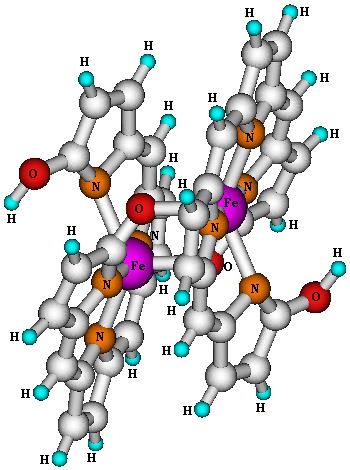
Designed basic elements of quantum computers are based
on DFT B3PW91/6-311G** model and Hartree-Fock/6-311G** proton NMR
calculations in biliverdin derivatives that generate up to eleven
quantum bits (Figure 1), EPR estimations in endohedral fullerenes
(Figure 2) possessing up to six QuBits for quantum computation and
nitrogen atom NMR in azo-fullerene CH2CH2NHC48N12
derivatives (Figure 3) generating up to twelve QuBits.
Figure 1.
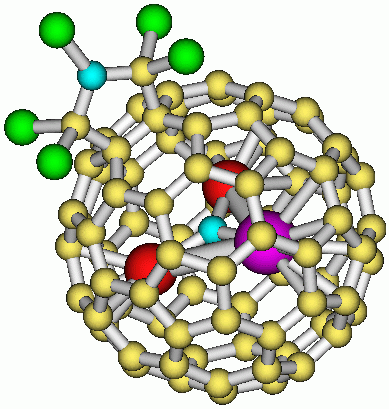
Figure 2.

Figure 3.
A molecular logic gate of classical digital molecular machine would change its quantum state in response to optical signal and pass the emitted electron via chip doing simultaneously trans-cis isomerization that predict motion [13]. Set of gates of classical digital molecular computers are designed using DFT B3PW91/6-311G - TD method based on light driven charge transfer in Disperse Orange azo-dyes [12] and fullerene-containing supermolecules (Figure 4).
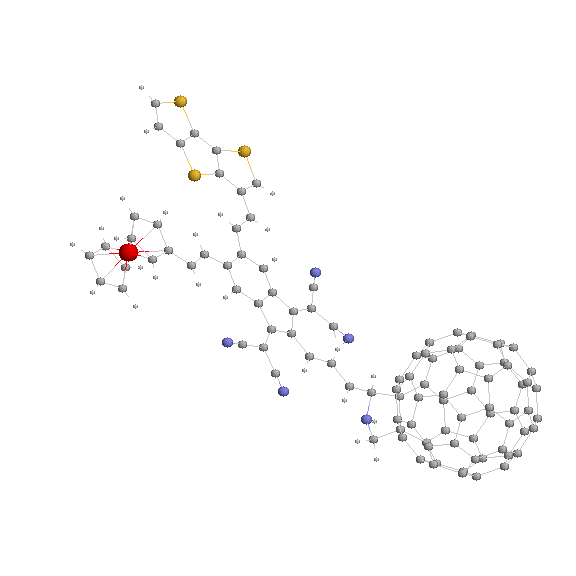
Figure 4.
It were designed various biologically active, fluorescencing [12], small-gap semiconductor and proton-transfer switching single supermolecular devices based on biliverdin, fluorescein, CdS organic nano-clusters (Figure 5) and white phosphorus organo-metallic complexes.
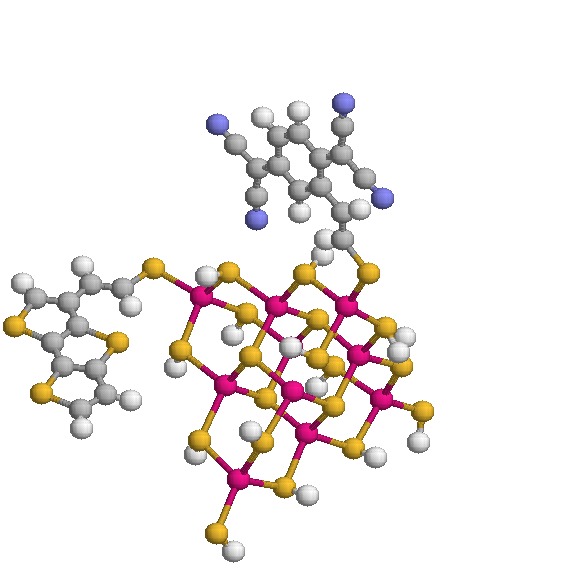
Figure 5.
References
[1] A. Tamulis, E. Stumbrys, V. Tamulis and J. Tamuliene, "Quantum Mechanical Investigations of Photoactive Molecules, Supermolecules, Supramolecules and Design of Basic Elements Molecular Computers", in NATO ASI series, High Technology; Vol. 9, Ed. by F. Kajzar, V. M. Agranovich and C. Y.-C. Lee, Photoactive Organic Materials: Science and Applications, June 25-30, 1995, Avignon, France, Kluver Academic Publishers, Doderecht/Boston/London, p.p. 53-66 1996.
[2] A. Tamulis, V. Tamulis, "Design of Basic Elements of Molecular Computers Based on Quantum Chemical Investigations of Photoactive Organic Molecules", Proceedings of the SPIE Photonics WEST Conference on Optoelectronics Integrated Circuits II, held in 24-30 January, 1998, San Jose Convention Center, San Jose, California, U.S.A., Volume 3290, p.p. 315-324.
[3] A. Tamulis, V. Tamulis and J. Tamuliene, Quantum Mechanical Design of Molecular Implementation of Two, Three and Four Variable Logic Functions for Electronically Genome Regulation, Viva Origino, 26, p.p. 127-146, 1998.
[4] A. Tamulis, J. Tamuliene, M.L. Balevicius, J.M. Nunzi, "Quantum Chemical Design of Multivariable Anisotropic Random-Walk Molecular Devices Based on Stilbene and Azo-Dyes", Proceedings of the 5th International Conference on Frontiers of Polymers and Advanced Materials, 21-25 June 1999, Poznan, Poland, published in the journal Mol. Cryst. Liq. Cryst, 2000, Vol. 354, p.p. 475-484.
[5] A. Tamulis, J. Tamuliene, M.L. Balevicius, J.-M. Nunzi, "Quantum Mechanical Investigations of Photoactive Molecules and Design of Molecular Machine and Logical Devices", published in the Proceedings of Photonics West 2000 conference, SPIE Conference Organic Photonics Materials and Devices II (OE04), held in San Jose, California, USA, January 22-28, 2000. Editors: Donald D. C. Bradley, Bernard Kippelen, Vol. 3939, p.p. 61-68.
[6] A. Tamulis, J. Tamuliene, M.L. Balevicius, J.-M. Nunzi, "Quantum Chemical Investigations of Disperse Orange 3 Molecule Cis-Trans Isomerization Through Linear Transition State and Design of Molecular Machines", in Applications of Photonic Technology 4, Roger A. Lessard, George A. Lamppropoulos, Editors, Proceedings of SPIE, vol. 4087, p.p. 662-670, 2000.
[7] A. Tamulis, Z. Rinkevicius, J. Tamuliene, V. Tamulis, M.L. Balevicius, A. Graja, "Ab initio quantum chemical design of supermolecule logical devices", in Optoelectronic Integrated Circuits and Packaging V, James G. Grote, Randy A. Heyler, Editors, Proceedings of SPIE Vol. 4290, p.p. 82-93, 2001.
[8] A. Tamulis, Z. Rinkevicius, V. Tamulis, J. Tamuliene, S.P. Karna, C.M. Stickley, "Ab Initio Quantum Chemical Design of Photoactive Molecular Logical Devices", Nonlinear Optics, vol. 27, p.p. 385-393, 2001.
[9] A. Tamulis, J. Tamuliene, M.L. Balevicius, Z. Rinkevicius, "Ab Initio Quantum Chemical Search of Per Linear Transition State of Azo-Dye Molecules and Design of Molecular Logical Machines", Nonlinear Optics, vol. 27, p.p. 481-488, 2001.
[10] J. Tamuliene, A. Tamulis, "Quantum Chemical ab initio Design of Molecular Electronics Tools for Biotechnologies",Biotech News International, vol. 6, No. 5, p.p. 12-14, 2001.
[11] A. Tamulis, Z. Rinkevicius, J. Tamuliene, "Molecular Classical Computer Basic Elements", in "Decoherence and Implication in Quantum Computation and Information Transfer" edited by T. Gonis and P.E.A. Turchi, NATO Science Series III Computer and Systems Sciences, vol. 182, p.p. 358-365, 2001.
[12] A. Tamulis, Z. Rinkevicius, J. Tamuliene, V. Tamulis, A. Graja, A.K. Gaigalas, "Quantum Chemical Design of Light Driven Molecular Logical Machines", in Eds. A. Graja, B.R. Bulka, F. Kajzar, "Molecular Low Dimentional and Nanostructured Materials for Advanced Applications", KLUWER Academic Publishers in NATO ASI Series: Mathematics, Physics and Chemistry, 2002, p.p. 209-219.
[13] M.-L. Balevicius, J. Tamuliene, A. Tamulis, A. Graja, "Isomerization Pathways of Azobenzene", in Eds. A. Graja, B.R. Bulka, F. Kajzar, "Molecular Low Dimentional and Nanostructured Materials for Advanced Applications", KLUWER Academic Publishers in NATO ASI Series: Mathematics, Physics and Chemistry, 2002, p.p. 289-292.